Skip to content
Why the Wrong Safety Boot Is a Bigger Problem Than You Think
Most people think any boot with a toecap will do the job. Pick the cheapest one on the shelf, get the site manager to sign it off, and you're compliant. Right?
Not quite. In the UK, slips, trips and falls account for 32% of all reported workplace injuries according to the HSE — and a significant portion of those involve footwear that technically met a safety standard but wasn't suited to the actual working environment.
A steel-capped boot that works perfectly on a construction site could be dangerously wrong for an electrician. An S1 boot that's fine in a dry warehouse becomes a liability the moment your team is working outdoors in a wet British winter. The difference isn't always obvious from looking at the boot — it's buried in the rating codes stamped on the insole.
This guide cuts through all of that. By the end, you'll know exactly what the markings mean, which rating your industry actually requires, and whether steel or composite is the right call for your workforce.
"The boot that keeps you safe is the one matched to your hazard — not the one that looks right on a shelf."
EN ISO 20345 Explained — What the Standard Actually Means
Every safety boot sold legally in the UK must comply with EN ISO 20345 — the European and International safety footwear standard. You'll see it printed on the insole of any compliant boot, often followed by a year (2011 or 2022) and a string of letters and numbers that tell you exactly what that boot protects against.
The most recent version is EN ISO 20345:2022+A1:2024, which replaced the 2011 standard with more precise testing methods and clearer markings. If you're buying new stock, aim for 2022-compliant boots — though existing 2011-certified stock remains valid until its certification expires.
Here's what the standard mandates as an absolute baseline for any boot carrying the EN ISO 20345 label:
A protective toecap capable of withstanding 200 joules of impact — equivalent to dropping a 20kg weight from 1.8 metres directly onto your toes — and a 15kN compression test (around 1.5 tonnes of static force). That's the floor. Everything else is an additional feature on top.
The letters after the standard number tell you what additional protections the boot provides. That's where it gets important — and where most buyers miss something critical.
S-Class Ratings: From SB to S7 — Decoded Simply
The S-class rating is the most important thing to check when buying safety boots in the UK. It's a shorthand summary of the protection package included. Here's a plain-English breakdown:
SB is the bare minimum — a toecap and nothing else. It's rarely the right choice outside a light-duty controlled indoor environment. S3 is the workhorse of the UK construction and trade industry, covering the most common outdoor hazards. S7 is S3 with full waterproofing built in — not just water-resistant, fully waterproof — and is increasingly standard for civil engineering, groundwork, and utilities.
Additional Codes to Know
You'll often see extra letters after the S-class. These are add-on certifications worth understanding:
When writing a PPE spec or RAMS document, reference the full code rather than just "safety boots." For example: "EN ISO 20345:2022 S3 SR LG WR" tells a supplier exactly what's needed and prevents substitution with under-specified product.
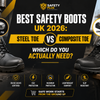
Steel Toe vs Composite Toe — An Honest Comparison
This is the question most buyers ask first. Both steel and composite toecaps must meet the same 200-joule impact standard to carry the EN ISO 20345 rating — so neither is "unsafe." But they perform differently in real-world conditions, and choosing wrong has consequences.
⚙️ Steel Toecap
- Maximum impact and compression resistance
- Generally lower unit cost at scale
- Slim profile fits standard boot lasts well
- Proven in heavy industry for decades
- Heavier — fatigue over long shifts
- Conducts heat and cold (uncomfortable in extremes)
- Triggers metal detectors — unsuitable for airports, prisons, secure sites
- Can transfer cold to toes in winter
🧪 Composite Toecap
- Significantly lighter — reduces end-of-day fatigue
- Non-metallic — airport/security site safe
- Thermally neutral — no heat or cold transfer
- ESD-compatible by design
- Slightly wider toe box profile on some styles
- Higher unit cost than basic steel equivalents
- Some styles less crush-resistant under extreme lateral force
Composite toecaps use a blend of plastics, carbon fibre, Kevlar, and fibreglass rather than formed steel. Both materials must survive the same laboratory test — the difference is in the working experience and the secondary properties.
For construction, warehousing, and general site work: steel is cost-effective and more than adequate. For electrical work, electronics, airports, cold environments, and long-shift comfort: composite is the clear choice. If in doubt and budget allows, composite is the more versatile option for a mixed workforce.
Slip Resistance Codes — SR, SRA, SRB, SRC Explained
Slip resistance is arguably as important as the toecap, given that slips and trips account for nearly a third of UK workplace accidents. The coding system changed in the 2022 standard update, so there's now a split between legacy codes still on older stock and the new unified SR marking.
The 2022 SR test is more rigorous than the old SRC because it specifically tests the heel strike and toe push-off points — the two areas where slip actually occurs when walking. If you're buying new stock, look for the SR marking. If you have existing SRC stock, it remains valid.
No slip-resistance rating eliminates slip risk entirely. Floor condition, contamination type, walking speed, and sole wear all affect performance. Complement the right boot with good housekeeping and wet floor procedures.
Which Boot for Which Industry — UK Recommendations
Rather than guessing from a product description, match the boot to your actual risk profile. Here are the most common UK sectors and what's genuinely required:
Construction & Civil Engineering
Outdoor exposure, groundwork, nail boards, wet conditions, ladders.
Ideal: S7 SR LG SC
Warehousing & Logistics
Forklift risk, concrete floors, pallet drops. Mostly dry and controlled.
Ideal: S3 SR (lightweight)
Electrical & Building Services
Static sensitive environments, ladders, metal detector access zones.
Composite toecap essential
Manufacturing & Engineering
Machine risk, oil/coolant floors, long shifts on hard standing.
Consider: HRO if welding present
Agriculture & Groundskeeping
Wet terrain, plant material, chemical exposure, uneven ground.
Wellington-style for wet/chemical
Healthcare & Facilities
Wet hard floors, chemical cleaning agents, long shifts, comfort priority.
Look for: Lightweight composite trainer
Don't procure one boot for an entire site. Different roles face different hazards. A groundworker and an electrician on the same project may need completely different specifications. Conduct a PPE risk assessment by role, not by site.
Sizing, Fit, and Comfort for Long Shifts
A boot that causes foot fatigue after four hours is failing its wearer — regardless of how many safety certifications it carries. Comfort and protection aren't in conflict, but poor sizing choices make them feel that way.
Here's what to get right when selecting safety boots for your team:
- 01Size up by half a size for heavy use. Feet swell during a shift. A boot that fits perfectly in the morning becomes painful by afternoon if there's no room for natural expansion.
- 02Check the toe box width separately from length. Composite caps often run slightly wider — beneficial for broader feet, potentially sloppy on narrow feet. Try before committing to bulk orders.
- 03Insoles matter as much as the boot itself. Factory insoles in most mid-range boots are functional but basic. For workers on hard standing all day (concrete, steel), an aftermarket ergonomic insole can dramatically reduce fatigue and long-term musculoskeletal risk.
- 04Lace types and ankle collar height affect ankle support and security on uneven ground. High-ankle styles protect against sprains on sites; low ankle styles suit workers who move frequently between surfaces.
- 05Waterproofing has a breathability trade-off. Fully waterproof membranes (GORE-TEX and equivalents) keep water out but reduce breathability — potentially worse in warm summer conditions than a water-resistant but breathable boot.
How to Care for Safety Boots — and When to Replace Them
Safety boots are PPE, not fashion footwear. Under PPER 2022, employers have a legal duty to maintain PPE in working condition. For safety footwear, that means regular inspection and timely replacement.
As a rule of thumb, safety boots last 12–18 months in typical heavy-use environments. But the right answer is condition-based, not calendar-based. Look for these replacement triggers:
- ✗Worn or delaminating sole. If the heel is worn unevenly or the sole is separating from the upper, the boot has failed — regardless of how new it looks on top.
- ✗Cracked or creased toecap area. A structural crack near the toecap suggests the safety protection has been compromised. Don't wait for visible damage to the cap itself.
- ✗Upper cracking or seam separation. Water, dirt, and contamination will enter — compromising both comfort and any waterproofing claims.
- ✗Compression history. If a boot has taken a significant impact hit (a heavy object dropped on the toe), replace it even if it looks undamaged. The toecap may have deformed microscopically and lost rated protection.
- ✗Loss of slip resistance. Soles worn smooth no longer provide the rated grip. This is one of the most common and most ignored failure modes.
Care routine to extend lifespan: Clean boots after each shift, remove insoles to dry overnight, condition leather uppers monthly, and store away from direct heat. Boots left damp repeatedly degrade significantly faster.
Keep a simple PPE inspection log for footwear — date issued, inspection dates, condition notes, and replacement date. It takes minutes per person and is your first line of defence in any HSE enforcement scenario or civil liability claim.