Skip to content
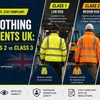
Hi-Vis Clothing Requirements UK: Class 1 vs Class 2 vs Class 3 Explained
- by GHC UK
Here's a scenario that plays out on UK sites every week. A procurement team orders 200 hi-vis vests — decent price, bright yellow, reflective tape, job done. Then the principal contractor's audit flags the lot: the site mandates Class 3 upper body protection, and the vests are Class 2. Two hundred garments, compliant with the standard but wrong for the site, and a workforce that can't start until replacements arrive.
The frustrating part? The difference was printed on the label the whole time. Every certified hi-vis garment in the UK carries an EN ISO 20471 mark with a class number — 1, 2 or 3 — and that number, not the colour or the brand, determines where the garment can legally and contractually be worn.
This guide breaks down exactly what each class requires, which industries mandate which class, what happens to certification when you add custom branding, and the replacement rules almost every buyer ignores until an audit forces the issue.
What EN ISO 20471 Means and Why It Matters
EN ISO 20471 is the standard for high-visibility clothing worn in high-risk situations — anywhere workers face moving vehicles, plant or rail traffic. To carry the mark, a garment must meet requirements across three areas:
- Fluorescent background material in one of three approved colours — fluorescent yellow, fluorescent orange-red or fluorescent red — which does the daytime work by converting UV light into visible brightness.
- Retroreflective tape that bounces vehicle headlights straight back at the driver, doing the night-time and low-light work.
- Design rules governing where the material sits on the body, so the wearer reads as a human figure from all angles, not just a bright patch.
The class number is determined by simple arithmetic: how many square metres of fluorescent background and reflective tape the garment carries. More material, higher class, greater visibility distance. That's the entire system — which is why a small vest can never be Class 3 no matter how bright it looks, and why sleeves matter more than most buyers realise.
Under UK law, hi-vis is PPE. The PPE at Work Regulations require employers to provide it free of charge where a risk assessment identifies the need — and providing the wrong class for the risk is treated the same as not providing it at all.
Class 1 vs Class 2 vs Class 3: The Breakdown
| Requirement | Class 1 | Class 2 | Class 3 |
|---|---|---|---|
| Fluorescent background material (min.) | 0.14 m² | 0.50 m² | 0.80 m² |
| Retroreflective tape (min.) | 0.10 m² | 0.13 m² | 0.20 m² |
| Typical garments | Trousers, harnesses, small accessories | Waistcoats, short-sleeve polos, gilets | Long-sleeve jackets, coveralls, jacket + trouser sets |
| Risk environment | Low — segregated from traffic | Medium — vehicles up to ~30 mph | High — fast roads, poor visibility, rail, airside |
| Sleeves required | No | No | Yes — torso plus sleeves and/or full-length trousers with banding |
Class 1 is the minimum certifiable level. On its own it's suitable only where vehicle risk is low and speeds are slow — car parks, segregated warehouse walkways, delivery work away from live traffic. In practice, Class 1 items like hi-vis trousers earn their keep as part of a combination: pair Class 1 trousers with a Class 2 top and the ensemble can be certified as Class 3.
Class 2 is the workhorse of UK industry — the standard hi-vis waistcoat most sites hand to visitors and general operatives. It's appropriate for medium-risk environments: construction sites with controlled traffic, warehouses with forklift movement, ports and yards where vehicle speeds are low.
Class 3 is the highest visibility level and the only class considered adequate where traffic is fast or conditions are poor. Crucially, a Class 3 garment must cover the torso and have sleeves with reflective bands — or be certified as a combination with hi-vis trousers. This is the detail that catches buyers out: no sleeveless vest, however large, can be Class 3 on its own. If a site says "Class 3", think long-sleeve hi-vis jackets or two-piece combinations, not bigger vests.
Industry Mandates: Who Requires What
Roads and highways. Working on or near live carriageways is where Class 3 is non-negotiable. Chapter 8 of the Traffic Signs Manual — the de facto rulebook for street works — and National Highways requirements mean workers on high-speed roads, motorways and dual carriageways wear Class 3 as standard, typically a long-sleeve jacket plus hi-vis trousers. For lower-speed urban street works, Class 2 with Class 1 trousers is common, but check the client specification: many highways contractors mandate full Class 3 regardless of road speed.
Rail. Rail is the exception on colour. Trackside workers under Network Rail requirements (RIS-3279-TOM) must wear fluorescent orange hi-vis — yellow is not permitted trackside, because it can be confused with signalling. Rail-spec garments are certified to both EN ISO 20471 and the rail standard; browse our dedicated rail spec hi-vis clothing range for compliant options.
Construction. There's no single national rule — the class is set by each site's risk assessment and the principal contractor's rules. Most major contractors mandate Class 2 minimum for everyone on site, with Class 3 for anyone working near site traffic routes, cranes or public roads. If you supply mixed sites, standardising on Class 3 jackets for outdoor trades removes the guesswork.
Airports. Airside operations almost universally require Class 3 — aircraft movement areas combine fast vehicles, huge sightline distances and round-the-clock operation. Check the specific aerodrome's airside safety rules before ordering.
Warehousing and logistics. Typically Class 2, driven by forklift and vehicle interaction. Where operatives work in yards shared with HGVs — especially at night — many operators step up to Class 3 hi-vis hoodies and sweatshirts or jackets for the added coverage in winter months anyway.
Utilities and energy. Where hi-vis meets flame risk — electrical utilities, gas, petrochemical — standard polyester hi-vis is the wrong answer entirely. These environments need garments certified for both visibility and flame resistance; see our flame retardant workwear range for dual-certified options.
Custom Branding on Hi-Vis: What's Allowed
Branded hi-vis is one of the smartest purchases in workwear — it turns a compliance item into site security (identifying who belongs on site) and walking advertising at the same time. But there's a certification catch that cheap print shops won't mention: badly placed branding can downgrade or invalidate the garment's class.
The rules are logical once you know the arithmetic behind the classes:
- Logos must never cover the retroreflective tape. The tape area is measured to the square centimetre; print over it and the garment no longer meets its certified class.
- Large dark logos reduce the fluorescent background area. A Class 2 vest carries 0.50 m² of background material with little to spare. Cover too much of it with a big printed panel and the garment arithmetic drops below the Class 2 threshold — it's now effectively Class 1, whatever the label says.
- Placement matters. Chest-left logos, small rear prints between (not over) the tape bands, and prints on non-fluorescent contrast panels are all generally safe. Full-width back prints need sizing carefully.
This is exactly why branding should be done by a supplier who understands the standard, not a generic print shop. Safety Plus runs an in-house custom workwear service — embroidery and print placed so garments retain their certified class, with bulk pricing for team orders. For high-volume site vests, our custom printed hi-vis waistcoats are the fastest route to branded, compliant kit; for winter, the custom print hi-vis bomber jacket covers the Class 3 outdoor use case with your logo on it.
Washing and Maintenance: Reflectivity Fades — and So Does Compliance
Hi-vis is the only PPE category that visibly wears out and yet routinely stays in service for years. The standard is clear that certification applies to the garment in serviceable condition, and two things quietly kill that condition:
- Wash cycles are counted. Every certified garment's label states a maximum number of wash cycles — commonly 25 to 50 — beyond which the manufacturer no longer guarantees the fluorescent and reflective performance. A vest washed weekly hits that ceiling within a year.
- Fading and contamination. UV exposure fades fluorescent dye; the "yellow" becomes a washed-out lime that no longer meets the luminance requirement. Ground-in dirt, oil and paint have the same effect faster. Cracked, peeling or delaminating reflective tape is an immediate fail.
A practical replacement rule for site managers: hold a new garment next to the worn one. If the colour difference is obvious at arm's length, the old garment is no longer doing its job at 200 metres in headlights. In heavy daily use — roads, rail, groundworks — expect to replace hi-vis every 6 to 12 months; lighter warehouse use stretches to 18–24. Wash inside out at low temperature, skip fabric softener (it coats the reflective tape), and never iron over the bands.
For procurement, the takeaway is to treat hi-vis as a consumable with a scheduled rotation, not a one-off purchase. Bulk replacement cycles cost less per unit and keep the whole workforce inside certification — our B2B team can set up volume pricing and repeat supply, branded or plain.
Frequently Asked Questions
Is a hi-vis vest enough for a construction site in the UK?
Usually yes for general site access — most principal contractors mandate Class 2 as the site minimum, which a certified waistcoat meets. But anyone working near site traffic routes, public roads or plant movement will typically need Class 3, which requires a sleeved garment or a certified top-and-trouser combination.
Can a sleeveless vest ever be Class 3?
No. Class 3 requires the garment to cover the torso and include sleeves with reflective bands, or be certified as a combination with hi-vis trousers. Surface area alone isn't enough — a bigger vest is still Class 2 at best.
Why do rail workers wear orange hi-vis instead of yellow?
Network Rail standards (RIS-3279-TOM) mandate fluorescent orange trackside because yellow can be confused with railway signalling colours. Rail-spec garments are certified to both EN ISO 20471 and the rail standard.
Does printing a logo on hi-vis affect its certification?
It can. Logos must not cover the reflective tape, and large dark prints reduce the fluorescent background area that determines the garment's class. Correctly sized and placed branding — done by a supplier who understands EN ISO 20471 — keeps the certification intact.
How often should hi-vis clothing be replaced?
When it's faded, contaminated or the tape is damaged — regardless of age. As a guide: 6–12 months in heavy outdoor use, 18–24 months in lighter indoor use, and never beyond the maximum wash cycles stated on the garment label.
Shop Certified Hi-Vis — Plain or Custom Branded, UK Stock
Safety Plus stocks EN ISO 20471 certified hi-vis across all three classes — vests, jackets, trousers and coveralls, plus ladies' fits and rail-spec orange. Add your company branding through our in-house embroidery and print service without compromising certification, with free UK mainland delivery on orders over £200 and extra discounts on bulk orders.
Get branded hi-vis for your team →
Need help matching classes to your site requirements? Call 0121 555 8446 or get in touch — supplying UK industry since 1988. More compliance guides on the Safety Plus blog, including our ESD safety footwear guide.